When studying for the CompTIA Security+ exam or beginning your journey into the dynamic field of cybersecurity, you will quickly discover that almost every single security policy, compliance framework, and technical control boils down to three core letters: The CIA Triad.
Often considered the foundational bedrock of all information security, the CIA Triad stands for Confidentiality, Integrity, and Availability. Understanding how these three elements interact, how they protect enterprise data, and how they are actively threatened by malicious actors is absolutely essential for passing your certification exams and securing modern enterprise network architectures against sophisticated cyber attacks.
In this comprehensive guide, we will break down each individual pillar of the CIA Triad, explore real-world cybersecurity breaches that highlight catastrophic failures in these areas, and test your knowledge with rigorous exam-style practice questions designed to mimic real testing conditions.
1. What is the CIA Triad?
The CIA Triad is a high-level security model designed to guide policies and defensive strategies for information security within any organization, regardless of its size or industry sector. Think of it structurally as a three-legged stool: if any single leg breaks or is compromised, the entire security posture of the organization collapses.
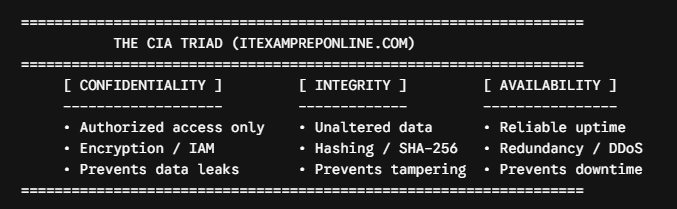
Security professionals rely on this framework to evaluate risks, prioritize security investments, and design multi-layered defense-in-depth strategies. Let us examine each component in detailed depth.
2. Pillar 1: Confidentiality
Definition and Core Principles:
Confidentiality ensures that sensitive, proprietary, or private information is accessed exclusively by authorized individuals, systems, or processes. It actively prevents the unauthorized disclosure of corporate or personal data, whether that data is sitting statically at rest on a hard drive, moving dynamically across a public network (in transit), or actively being processed inside a system’s memory (in use).
Core Technical Mechanisms:
- Encryption: Transforming readable plaintext into completely unreadable ciphertext utilizing cryptographic algorithms such as AES-256 or RSA.
- Access Controls: Implementing rigid principles like Least Privilege and Role-Based Access Control (RBAC) via centralized identity management systems like Active Directory or enterprise IAM platforms.
- Steganography and Data Masking: Hiding data within other files or redacting sensitive fields (such as credit card numbers or Social Security digits) to prevent exposure.
Real-World Example of Confidentiality Failure:
A major healthcare provider suffers a catastrophic data breach because database administrators left unencrypted backups sitting exposed on an open cloud storage bucket. Unauthorized external attackers discover the bucket via automated port and storage scanning, instantly downloading the medical records and Social Security numbers of thousands of patients. This represents a complete and total failure of Confidentiality.
3. Pillar 2: Integrity
Definition and Core Principles:
Integrity ensures that data and system configurations remain accurate, complete, and fully trustworthy. It guarantees that information has not been improperly altered, modified, forged, or destroyed by unauthorized actors or through accidental system corruption.
Core Technical Mechanisms:
- Hashing: Utilizing cryptographic hash functions (such as SHA-256) to generate unique checksums that verify whether a file or code snippet has been altered in transit or at rest.
- Digital Signatures: Providing non-repudiation and verifying the exact authenticity of software updates or email messages.
- Version Control & Access Auditing: Tracking precisely who modified data, when the modification took place, and what changes were introduced.
Real-World Example of Integrity Failure:
A sophisticated threat group intercepts a software update file intended for a fleet of industrial IoT smart meters, modifying the firmware code to inject a hidden remote access backdoor. When the devices automatically download and install the update, their underlying operational logic is secretly corrupted. This is a severe breach of Integrity.
4. Pillar 3: Availability
Definition and Core Principles:
Availability ensures that authorized users have timely, reliable, and uninterrupted access to data, critical applications, and network services whenever they are required for business operations.
Core Technical Mechanisms:
- Redundancy and High Availability: Implementing redundant hardware components, dual power supplies, RAID storage arrays, and clustered server environments.
- Failover Clusters & Load Balancers: Distributing network traffic efficiently and ensuring backup systems automatically take over if primary hardware fails unexpectedly.
- Disaster Recovery & Backups: Maintaining offsite hot, warm, or cold recovery sites along with regular, tested backup schedules.
- DDoS Mitigation: Utilizing cloud-based scrubbing centers and web application firewalls to absorb and defeat high-volume Denial-of-Service attacks.
Real-World Example of Availability Failure:
A malicious extortion group launches a massive Distributed Denial-of-Service (DDoS) attack against a major online banking portal, flooding its front-end web servers with millions of fraudulent connection requests. Legitimate account holders can no longer log in to check balances, transfer funds, or pay bills. This represents a critical breakdown of Availability.
5. Summary Table: The CIA Triad Pillars at a Glance
| Pillar | Primary Goal | Common Protective Controls | Real-World Attack Example |
| Confidentiality | Prevent unauthorized data disclosure | Encryption, Access Controls (IAM), MFA | Data exfiltration / Cloud bucket leaks |
| Integrity | Prevent unauthorized data modification | Hashing (SHA-256), Digital Signatures | Firmware tampering / Man-in-the-Middle |
| Availability | Ensure reliable access for authorized users | Redundancy, Backups, Load Balancing, DDoS protection | Ransomware lockouts / DDoS attacks |
6. Exam-Style Practice Questions for Security+
Practice Question 1
Question: A hospital database administrator discovers that an external attacker managed to intercept patient record transmissions and modify prescription dosages embedded in the database stream before they reached the pharmacy department. Which pillar of the CIA Triad has been primarily compromised?
- A) Confidentiality
- B) Integrity
- C) Availability
- D) Non-repudiation
Correct Answer: B) Integrity
Explanation:
- Integrity ensures that data remains accurate and has not been maliciously or accidentally altered, forged, or tampered with in transit or at rest.
- Why not A: Confidentiality involves unauthorized viewing or disclosure, not data modification.
- Why not C: Availability deals with system uptime and accessibility, not data content alteration.
Practice Question 2
Question: An enterprise e-commerce platform deploys redundant cloud servers, multi-region load balancers, and automated failover protocols to protect its storefront from going offline during peak holiday shopping hours. Which element of the CIA Triad are these engineering controls primarily designed to protect?
- A) Confidentiality
- B) Integrity
- C) Availability
- D) Identification
Correct Answer: C) Availability
Explanation:
- Redundancy, failover clusters, and load balancers are classic infrastructure controls built explicitly to guarantee system uptime and ensure that services remain continuously accessible to authorized users.
Master Your Security+ Prep & Next Steps
- 🚀 Test your exam readiness: Put your knowledge to the test with my comprehensive CompTIA Security+ 6 Full Mock Exams (90 Questions Each) on Udemy to master complex scenario-based questions under real testing pressure.
- 📚 Master the Domains: Learn concepts thoroughly domain by domain with my CompTIA Security+ Domain-by-Domain Course on Udemy.
- 📖 Recommended Reading: Keep the CompTIA Security+ Get Certified Get Ahead: SY0-701 Study Guide by Darril Gibson nearby for quick reference on security principles and core compliance frameworks.
- 📺 Scenario-Based Practice Tests: Check out my YouTube channel.