
When preparing for the CompTIA Security+ exam, mastering cryptography is non-negotiable. Cryptography is the backbone of modern digital privacy, securing everything from online banking transactions to confidential corporate emails. Among the most foundational concepts you must understand are the two primary types of encryption: Symmetric and Asymmetric.
While both methods are designed to protect data by turning plaintext into unreadable ciphertext, they operate on completely different mathematical principles, use different types of keys, and serve unique purposes in an enterprise network.
In this comprehensive guide, we will break down how symmetric and asymmetric encryption work, compare their core differences, explore their strengths and weaknesses, and test your knowledge with exam-style practice scenarios.
1. What is Symmetric Encryption? (The Shared Key Model)
Symmetric encryption is the oldest and most straightforward method of encrypting data. In a symmetric system, the exact same cryptographic key is used for both encryption (locking the data) and decryption (unlocking the data).
How It Works:
- Alice has a secret file (plaintext).
- Alice uses a specific secret key and an encryption algorithm (like AES) to scramble the file into ciphertext.
- Alice transmits the ciphertext to Bob.
- For Bob to read the file, he must possess a copy of that exact same secret key to decrypt the ciphertext back into plaintext.
Real-World Analogy:
Think of symmetric encryption like a traditional house deadbolt. You use a physical key to lock the front door from the outside, and that exact same physical key is required to unlock it from the inside. Anyone who holds a copy of that key can both lock and unlock the door.
Common Symmetric Algorithms:
- AES (Advanced Encryption Standard): The current global gold standard for symmetric encryption. It supports key sizes of 128, 192, and 256 bits and is used everywhere from Wi-Fi security (WPA2/WPA3) to secure file transfers.
- DES (Data Encryption Standard): A legacy, 56-bit block cipher that is entirely obsolete and broken due to modern computing power.
- 3DES (Triple DES): An older interim fix that applied the DES algorithm three times to each data block. It is also deprecated and replaced by AES.
- Blowfish / Twofish: Fast symmetric block ciphers designed by Bruce Schneier. Twofish was a finalist in the AES competition.
- RC4 / RC5 / RC6: Rivest Ciphers. RC4 is a stream cipher that was historically used in WEP and early TLS versions, but it is now considered cryptographically broken.
The Major Challenge of Symmetric Encryption:
The Key Exchange Problem. If Alice and Bob want to communicate securely using symmetric encryption over an insecure public network (like the internet), how does Alice securely send the secret key to Bob without an attacker intercepting it along the way? If an attacker steals the key, they can decrypt all past and future communications.
2. What is Asymmetric Encryption? (The Public-Private Key Pair)
Asymmetric encryption, also known as Public-Key Cryptography, was developed to solve the key exchange problem inherent in symmetric systems. Instead of using a single shared key, asymmetric encryption uses mathematically linked key pairs: a Public Key and a Private Key.
How The Key Pair Works:
- Public Key: Can (and should) be shared openly with anyone. Its sole purpose is to encrypt data or verify digital signatures.
- Private Key: Kept strictly secret by the owner. Its sole purpose is to decrypt data encrypted by its corresponding public key, or to create digital signatures.
How Secure Communication Works:
- Bob wants to send a private message to Alice.
- Bob looks up Alice’s publicly available Public Key.
- Bob uses Alice’s Public Key to encrypt his message.
- Bob sends the ciphertext over the network. Even if an attacker intercepts this ciphertext, the attacker cannot decrypt it using the public key.
- Only Alice, using her secret Private Key, can unlock and read the message.
Real-World Analogy:
Imagine an open mailbox mounted on a post outside a house. Anyone in the neighborhood (the public) can walk up to the box, drop a sealed letter through the mail slot (using the public key to lock the message away), and walk away. However, only the homeowner possesses the physical key to open the locked box and retrieve the letters (the private key).
Common Asymmetric Algorithms:
- RSA (Rivest-Shamir-Adleman): One of the first and most widely used asymmetric algorithms, relying on the mathematical difficulty of factoring large prime numbers.
- ECC (Elliptic Curve Cryptography): A modern asymmetric alternative that provides the same level of security as RSA but uses much smaller key sizes, making it ideal for resource-constrained mobile devices and IoT hardware.
- Diffie-Hellman (DH) / DHE: Primarily used for secure key exchange (allowing two parties to establish a shared secret over an insecure channel safely), rather than encrypting bulk data.
- DSA (Digital Signature Algorithm): Used primarily for digital signatures and authentication rather than encryption.
3. Side-by-Side Comparison Table: Symmetric vs. Asymmetric
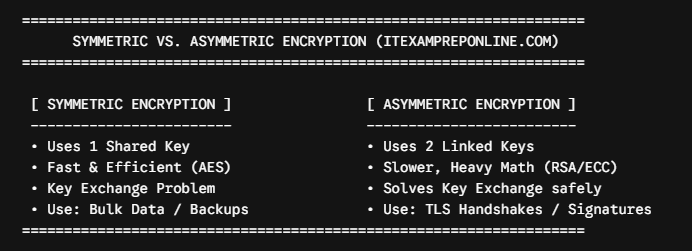
| Feature | Symmetric Encryption | Asymmetric Encryption |
| Number of Keys | One shared key (used for both encrypt/decrypt) | Two linked keys (Public and Private) |
| Speed / Performance | Extremely fast. Requires low CPU overhead. | Slow. Requires heavy mathematical computation. |
| Primary Use Case | Encrypting large volumes of data (bulk data transmission, file storage). | Secure key exchange, digital signatures, identity authentication, TLS/SSL handshakes. |
| Key Distribution | Difficult and risky over public channels (The Key Exchange Problem). | Easy and secure (Public keys can be freely distributed). |
| Key Algorithms | AES, 3DES, Blowfish, RC4 | RSA, ECC, Diffie-Hellman, DSA |
4. How They Work Together: Hybrid Cryptography in the Real World
If symmetric encryption is fast but has a dangerous key exchange problem, and asymmetric encryption solves the key exchange problem but is painfully slow for large files, what do we do in practice?
We combine them into a Hybrid Cryptosystem (used daily in HTTPS, SSH, and VPN tunnels):
- Asymmetric Initialization: When your web browser connects securely to an e-commerce website via HTTPS, an asymmetric handshake (like TLS handshake using RSA or ECC) occurs first. They safely authenticate each other and exchange a temporary, random symmetric key.
- Symmetric Bulk Transfer: Once that symmetric key is safely shared between your browser and the server, the asymmetric phase ends. All subsequent web traffic (streaming videos, shopping carts, passwords) is encrypted using fast symmetric encryption (AES) utilizing that temporary key.
5. Exam-Style Practice Questions for Security+
Practice Question 1
Question: A security administrator needs to configure an encryption mechanism that can rapidly secure large volumes of database backups moving across a corporate wide-area network. The solution must minimize CPU overhead while ensuring strong data confidentiality. Which cryptographic approach is best suited for this requirement?
- A) Asymmetric encryption using RSA-2048
- B) Symmetric encryption using AES-256
- C) Hash algorithms using SHA-256
- D) Asymmetric encryption using ECC
Correct Answer: B) Symmetric encryption using AES-256
Explanation:
- Symmetric encryption (such as AES-256) is specifically designed for high-speed, low-overhead encryption of large volumes of data (bulk data).
- Why not A or D: Asymmetric algorithms like RSA and ECC are computationally expensive and too slow for large database backups.
- Why not C: Hashing (SHA-256) provides data integrity verification, not confidentiality or encryption.
Practice Question 2
Question: Two remote system administrators need to establish a shared secret key over an unsecure public network so they can subsequently communicate using AES encryption. Which of the following algorithms is specifically designed to facilitate secure key exchange over a public channel?
- A) RSA
- B) Diffie-Hellman
- C) MD5
- D) HMAC
Correct Answer: B) Diffie-Hellman
Explanation:
- Diffie-Hellman (DH) is a foundational cryptographic protocol designed explicitly to allow two parties to establish a shared secret key over an insecure communications channel without transmitting the key itself.
- Why not A: While RSA can encrypt keys, Diffie-Hellman is the dedicated protocol standard for key agreement exchanges.
- Why not C or D: MD5 is a hashing algorithm, and HMAC is a hash-based message authentication code used for integrity, not key exchange.
Master Your Security+ Prep & Next Steps
- 🚀 Test your exam readiness: Put your knowledge to the test with my comprehensive CompTIA Security+ 6 Full Mock Exams (90 Questions Each) to master complex scenario-based questions.
- 📚 Master the Domains: Learn concepts thoroughly domain by domain with my CompTIA Security+ Domain-by-Domain Course.
- 📺 Scenario-Based Practice Tests: Check out my YouTube channel for it.
- 📖 Recommended Reading: Keep the CompTIA Security+ Get Certified Get Ahead: SY0-701 Study Guide by Darril Gibson nearby for quick reference on cryptographic algorithms and security controls.