For the CompTIA Network+ exam, understanding how routers communicate is non-negotiable. While static routing works for tiny, predictable networks, enterprise environments and the global internet rely entirely on dynamic routing protocols. These protocols allow routers to dynamically share topology information, calculate the best paths, and adapt automatically when a link fails.
In this comprehensive guide, we will break down how routing protocols work, categorize them by their algorithms, and review the essential protocols you must know to pass your exam.
1. Static vs. Dynamic Routing: The Core Difference
Before looking at specific protocols, you need to understand the philosophy of routing:
- Static Routing: An administrator manually configures every route on a router. It is secure and uses zero router processing power for path discovery, but it is entirely non-scalable. If a link goes down, traffic drops unless a backup static route is manually defined.
- Dynamic Routing: Routers run software protocols (like OSPF or BGP) to automatically discover other routers, share network maps, and recalculate paths when topology changes occur.
2. Categories of Dynamic Routing Protocols
CompTIA loves testing your knowledge on how these protocols group together. They fall into two major functional families (IGP and EGP), which you can see summarized in the diagram below:
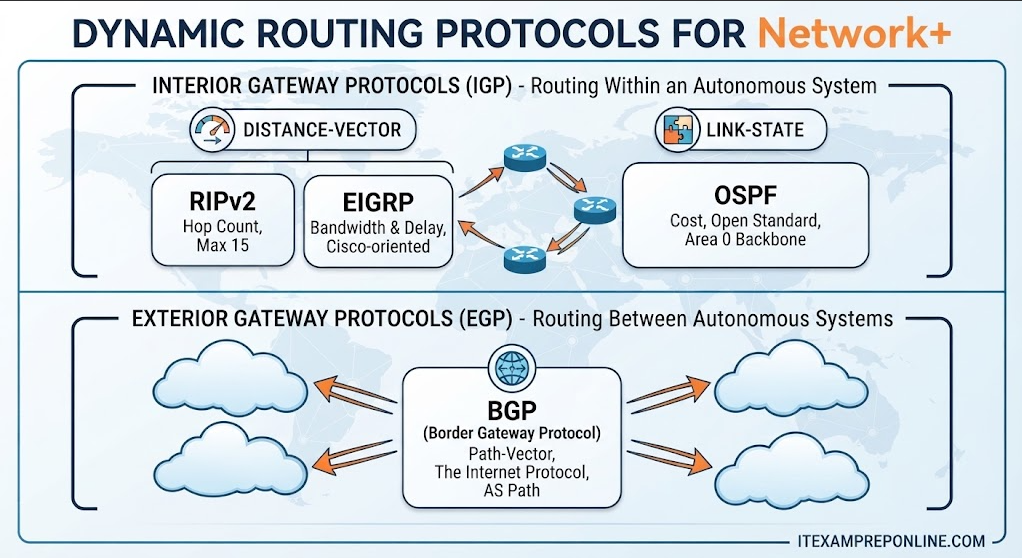
- IGP (Interior Gateway Protocols): Used to route traffic within a single organization, enterprise, or Autonomous System (AS). Examples include RIP, OSPF, and EIGRP.
- EGP (Exterior Gateway Protocols): Used to route traffic between different Autonomous Systems across the global internet. The undisputed king here is BGP.
Furthermore, protocols use different algorithms to decide what the “best path” is:
- Distance-Vector: Uses hop count or a simple metric; routers share their entire routing tables with direct neighbors periodically.
- Link-State: Builds a complete topological map of the entire network; routers calculate the shortest path independently using Dijkstra’s algorithm.
3. The Essential Routing Protocols for Network+
I. RIP (Routing Information Protocol / RIPv2)
- Type: Distance-Vector (IGP)
- Metric: Hop count (Maximum limit is 15 hops; 16 hops means unreachable).
- Overview: RIP is an older, simple protocol. RIPv1 is classful and outdated, while RIPv2 supports classless routing (CIDR) and multicast updates. Because of its strict 15-hop limit, it is only suitable for very small, legacy networks.
II. OSPF (Open Shortest Path First)
- Type: Link-State (IGP)
- Metric: Cost (calculated based on link bandwidth).
- Overview: One of the most important protocols on the exam. OSPF uses areas to scale efficiently, converges very quickly, and supports both IPv4 (OSPFv2) and IPv6 (OSPFv3).
III. EIGRP (Enhanced Interior Gateway Routing Protocol)
- Type: Advanced Distance-Vector / Hybrid (IGP)
- Metric: Composite metric based primarily on Bandwidth and Delay.
- Overview: Originally a Cisco-proprietary protocol, EIGRP is now partially open standard. It features extremely fast convergence times.
IV. BGP (Border Gateway Protocol)
- Type: Path-Vector (EGP)
- Metric: Path attributes and autonomous system (AS) path policies.
- Overview: BGP is the protocol that holds the entire internet together. It routes packets between massive independent networks (like ISPs) based on administrative policies.
4. Scenario-Based Exam Practice Question
Question: A network administrator is designing an enterprise internal network composed of dozens of multi-vendor routers. The design requires fast convergence, support for variable-length subnet masks (VLSM), and an open-standard link-state algorithm. Which routing protocol should the administrator choose?
- A) RIPv2
- B) EIGRP
- C) OSPF
- D) BGP
Correct Answer: C) OSPF.
Explanation:
- OSPF is an open-standard link-state protocol that supports VLSM and converges very rapidly, making it the industry standard for multi-vendor enterprise interiors.
Master Your Network+ Prep
- 🚀 Boost your prep: Access my CompTIA Network+ 6 Full Mock Exams.
- 📚 Recommended Reading: Keep the CompTIA Network+ N10-008 Cert Guide by Anthony Sequeira nearby.
- 📺 Practice Tests Learning: Subscribe to my YouTube channel.