The transition from IPv4 to IPv6 is one of the most significant topics in networking. While IPv4 is still widely used, IPv6 is the future. For your CompTIA Network+ exam, you need to know how to identify them, understand their limitations, and recognize how they coexist.
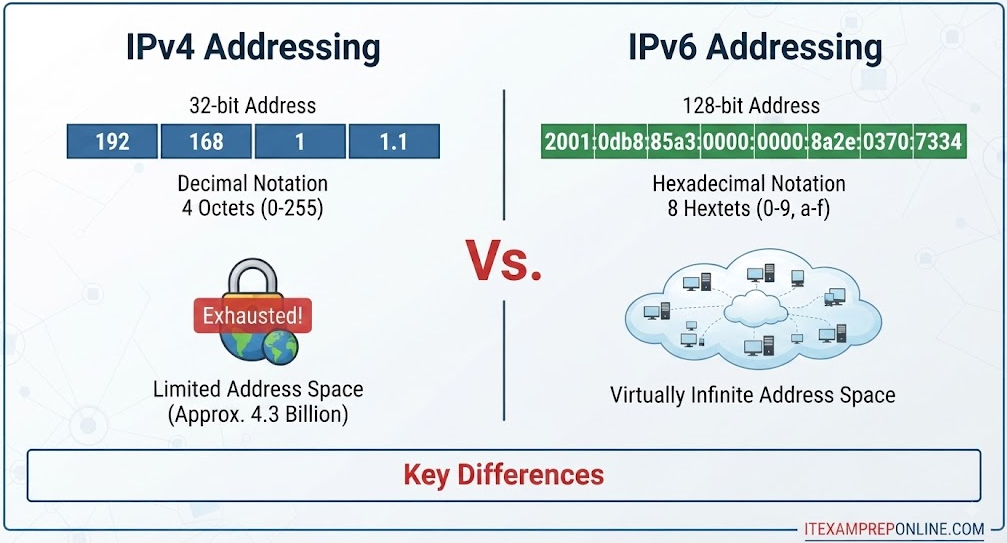
| Feature | IPv4 | IPv6 |
| Address Length | 32-bit | 128-bit |
| Notation | Decimal (4 octets, e.g., 192.168.1.1) | Hexadecimal (8 groups, e.g., 2001:db8::1) |
| Total Addresses | ~4.3 Billion (Exhausted!) | ~340 undecillion (Virtually infinite) |
| Configuration | Manual, DHCP | SLAAC, DHCPv6, Manual |
| Security | Optional (IPsec) | Built-in (Native IPsec) |
2. Deep Dive: Decoding the Addresses
IPv4: The Old Guard
- Format: Four decimal numbers separated by dots.
- Example:
172.16.254.1 - The Problem: We ran out of addresses! We use workarounds like NAT (Network Address Translation) to share one public IP among many private devices.
IPv6: The New Standard
- Format: Eight groups of four hexadecimal digits (0-9, A-F), separated by colons.
- Example:
2001:0DB8:85A3:0000:0000:8A2E:0370:7334 - The Cheat Codes (Exam Tips):
- Leading zeros can be dropped:
0DB8becomesDB8. - Double colons (
::) can replace ONE contiguous block of zeros:2001:DB8:0:0:0:0:0:1becomes2001:DB8::1.
- Leading zeros can be dropped:
3. Scenario-Based Problem (Network+ Exam Style)
Question: A network administrator is configuring a new device on a network that uses both IPv4 and IPv6. The device needs to automatically receive an address without a DHCPv6 server being present on the segment. Which IPv6 feature should be used?
- A) NAT
- B) SLAAC
- C) APIPA
- D) Subnetting
Correct Answer: B) SLAAC (Stateless Address Autoconfiguration).
Explanation: SLAAC is a key feature of IPv6 that allows a device to configure its own IPv6 address automatically based on the Router Advertisement (RA) messages it receives from the local gateway, without needing a DHCP server.
- Why it’s not A: NAT is primarily an IPv4 workaround.
- Why it’s not C: APIPA is the automatic private addressing for IPv4 (
169.254.x.x).
4. Why This Matters for Your Career
Understanding the difference isn’t just about passing the test; it’s about architecture. Knowing that IPv6 doesn’t require NAT means your network security model changes. You move from “hiding” behind a firewall to “securing” every single device with native IPsec.
Master Your Network+ Prep
- 🚀 Get Exam Ready: Practice these scenarios with my CompTIA Network+ 6 Full Mock Exams. It includes 540 questions covering address types, subnetting, and protocol headers.
- 📚 Recommended Resource: Keep the CompTIA Network+ N10-008 Cert Guide by Anthony Sequeira handy for the IPv6 compression rules chart.
- 📺 Practice Learning: Check my YouTube channel for scenario based Network+ Practice tests.